
Doctor at Home vs. Going to the Hospital: A Decision Guide for Families in Mauritius
When someone in your family falls ill or gets injured, one question comes up immediately: should we call a doctor to the house, or should we go to the hospital? The answer depends on the situation — and getting it right matters. Going to the hospital for something a home doctor can handle means hours in a waiting room. But staying home when hospital care is genuinely needed can be dangerous.
This guide gives families in Mauritius a clear framework for making that decision quickly and confidently — based on the type of symptoms, the level of urgency, and who the patient is.
The Simple Rule
Here is the simplest way to think about it:
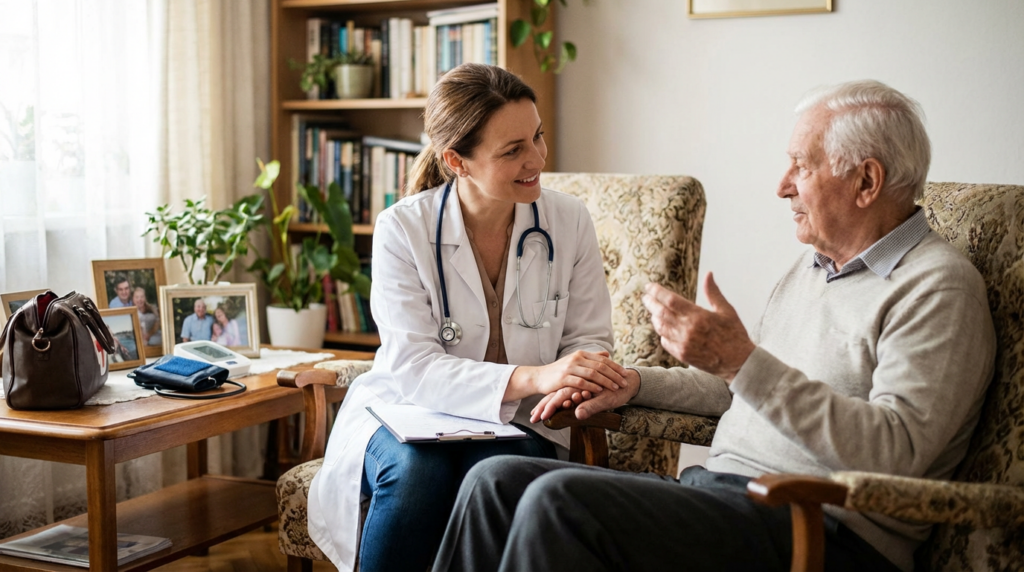
Call a home doctor when the patient is unwell but stable — meaning they are conscious, breathing normally, and not in immediate danger. This covers the vast majority of medical situations that families face.
Go to the hospital (or call an ambulance) when the patient is in a life-threatening situation — meaning they are unconscious, having severe difficulty breathing, experiencing chest pain with signs of a heart attack, bleeding heavily and uncontrollably, or showing signs of stroke.
If you are unsure, calling 86121 is always a safe first step. The medical coordination team can help you assess the urgency over the phone and advise whether a home visit is appropriate or whether you should go directly to the hospital.
When to Call a Home Doctor
A home doctor visit is the right choice for urgent but stable conditions — situations where you need professional medical attention but the patient is not in immediate danger. This covers far more than most people realise.
Fever and flu-like illness
High fever, body aches, sore throat, cough, runny nose, and general malaise are among the most common reasons families call a home doctor. A doctor can assess severity, check for complications like dehydration or secondary infection, prescribe medication, and administer IV fluids if needed — all at your bedside. There is no medical benefit to sitting in a hospital waiting room with a fever when the same care can come to you. Read our guide on managing fever at home.
Vomiting and diarrhoea
Food poisoning, gastroenteritis, and stomach viruses cause intense vomiting and diarrhoea that can lead to dehydration — especially in children and elderly patients. A home doctor can assess hydration levels, administer anti-nausea injections and IV rehydration at your bedside, and determine whether the illness is self-limiting or needs further investigation. Travelling to a hospital while actively vomiting is both impractical and unnecessary. Read about food poisoning treatment at home.
Pain management
Back pain, sciatica, migraines, abdominal cramps, kidney pain, and joint pain can be assessed and treated at home. A doctor can perform a clinical examination, administer pain relief (oral, intramuscular, or IV), and prescribe ongoing treatment — often more effectively than a rushed clinic consultation.
Infections
Urinary tract infections, ear infections, skin infections, eye infections, sinus infections, and respiratory infections can all be diagnosed and treated during a home visit. The doctor can prescribe antibiotics, administer injections if needed, and arrange follow-up care.
Wound care
Minor cuts, burns, post-surgical wounds, coral cuts, abrasions, and wounds needing cleaning, dressing, or stitches can be handled at home by a doctor with the right equipment. Read the wound care guide.
Chronic condition flare-ups
Diabetes emergencies (high or low blood sugar), asthma attacks that respond to nebuliser treatment, hypertension spikes, and arthritis flare-ups can be managed at home. The doctor can stabilise the patient, adjust medication, and monitor until the crisis passes.
Allergic reactions (mild to moderate)
Skin rashes, hives, swelling from insect bites, and mild allergic reactions can be treated at home with antihistamines and monitoring. If the reaction involves breathing difficulty or throat swelling, that becomes a hospital situation.
Elderly patients feeling unwell
For elderly patients with limited mobility, travelling to a hospital is physically difficult and often stressful. A home doctor can perform a full assessment, run an ECG, administer IV fluids, and manage most acute conditions at home — in an environment where the patient feels safe and comfortable. Learn about elderly home doctor visits.
Children with non-emergency illness
Fever, ear infections, vomiting, rashes, and respiratory infections in children are stressful for both the child and the parents. A home doctor visit avoids the anxiety of a hospital waiting room and provides faster, focused assessment in the environment where the child is most comfortable. Read about pediatric home visits.
Medical certificates and prescriptions
If you need a medical certificate for work, a prescription renewal, or a follow-up after a recent illness, a home visit is faster and more convenient than a clinic appointment.
When to Go to the Hospital
Some situations require hospital-level resources that a home doctor — no matter how well equipped — cannot provide. These include imaging (X-rays, CT scans, MRI), surgery, intensive care monitoring, and specialist equipment.
Go to the hospital immediately if:
- Chest pain with shortness of breath — possible heart attack. Call an ambulance.
- Sudden weakness on one side of the body, slurred speech, or facial drooping — possible stroke. Every minute counts.
- Unconsciousness or unresponsiveness — the patient needs emergency assessment and monitoring.
- Severe difficulty breathing that does not improve with a nebuliser or inhaler — possible severe asthma attack, anaphylaxis, or pulmonary emergency.
- Heavy uncontrolled bleeding that does not stop with direct pressure after 10 minutes.
- Suspected fractures or dislocations — bones that appear deformed, inability to move a limb after injury, severe swelling after a fall.
- Severe head injury — loss of consciousness after a blow to the head, confusion, vomiting, or clear fluid from the ears or nose.
- Seizures lasting more than 5 minutes or multiple seizures without full recovery in between.
- Severe burns covering a large body area, burns to the face, hands, or genitals, or chemical and electrical burns.
- Suspected poisoning or overdose — bring the substance or medication packaging to the hospital.
In these situations, call an ambulance or go directly to the nearest hospital emergency department. Médecin à Domicile also provides ambulance services — call 86121 if you need emergency transport.
The Grey Area: When You Are Not Sure
Many situations fall somewhere between “clearly fine at home” and “clearly needs hospital.” Here is how to handle the most common grey-area scenarios.
High fever that is not responding to paracetamol
Start with a home doctor. The doctor can assess whether the fever is caused by a viral infection (most common), bacterial infection requiring antibiotics, or something more serious like dengue. IV fluids and stronger medication can be administered at home. Hospital referral is only needed if the doctor identifies warning signs.
Abdominal pain
Mild to moderate abdominal pain usually has a benign cause — gastritis, constipation, menstrual cramps, food intolerance. A home doctor can examine you, check for signs of appendicitis or other surgical conditions, and treat or refer accordingly. Severe, sudden abdominal pain with rigidity and vomiting — go to the hospital.
Breathing difficulty
If the patient has a known condition like asthma and the breathing difficulty is responding to their inhaler or nebuliser — a home doctor can provide treatment and monitoring. If the breathing difficulty is sudden, severe, and not improving — go to the hospital immediately.
Falls in elderly patients
If the patient can move all limbs, there is no visible deformity, and pain is manageable — a home doctor can assess for fractures, sprains, and head injury without the patient travelling. If there is suspected hip fracture (inability to stand, severe pain, shortened and rotated leg) — the patient needs hospital imaging.
Child with a febrile seizure
If the seizure has stopped, the child is breathing normally, and is becoming responsive — call a home doctor for immediate assessment. If the seizure lasts more than 5 minutes or the child is not recovering — go to the hospital.
What a Home Doctor Can Do That Many People Don’t Realise
Most families in Mauritius think of a home doctor as someone who writes a prescription and leaves. In reality, the range of care available at home has expanded significantly. Through Médecin à Domicile, a doctor visiting your home can administer IV fluids and IV medications at your bedside, give intramuscular injections (antibiotics, pain relief, anti-nausea), perform an ECG and interpret results on the spot, collect blood samples for laboratory testing, clean, suture, and dress wounds, provide nebuliser therapy for respiratory conditions, monitor and stabilise chronic condition flare-ups, issue medical certificates and prescriptions, and arrange hospital transfer or ambulance if the situation requires it.
This means the vast majority of conditions that families encounter — including many that feel alarming in the moment — can be fully managed at home without a hospital visit. View the full range of services.
The Practical Advantages of Calling a Home Doctor
Beyond the medical capability, there are practical reasons why a home visit is often the better choice.
No waiting room. Hospital emergency departments in Mauritius can have wait times of several hours for non-critical cases. A home doctor arrives at your door and focuses entirely on your case.
No infection exposure. Waiting rooms are full of other sick people. If your child has a fever, the last place you want them is sitting next to someone with a respiratory infection. At home, the risk of picking up a secondary illness is zero.
Better for children and elderly patients. Sick children are calmer and more cooperative when examined at home. Elderly patients with mobility issues avoid the physical strain and disorientation of hospital travel.
Available 24/7. Clinics close. Doctors’ offices have limited hours. Médecin à Domicile operates 24/7 — including 2 a.m. on a Sunday, public holidays, and everything in between.
Insurance-covered. Many home doctor visits are claimable through your insurer. Patients with Eagle Insurance or Jubilee Insurance can access cashless visits with no upfront payment.
Quick Decision Reference
Call 86121 for a home doctor:
- Fever, flu, cold, sore throat, cough
- Vomiting, diarrhoea, food poisoning
- Pain (back, head, stomach, joints, muscles)
- Infections (ear, throat, skin, urinary, respiratory)
- Wound care, minor cuts, stitches
- Allergic reactions (mild to moderate)
- Chronic condition flare-ups (diabetes, asthma, hypertension)
- Elderly patient feeling unwell
- Sick child (fever, vomiting, rash, ear infection)
- IV fluids, injections, nebuliser treatment
- ECG, blood tests, medical certificates
Go to the hospital:
- Chest pain with breathing difficulty
- Signs of stroke (facial drooping, weakness, slurred speech)
- Unconsciousness
- Severe uncontrolled bleeding
- Suspected fractures or dislocations
- Severe head injury
- Prolonged seizures
- Severe burns
- Poisoning or overdose
Not sure? Call 86121 first.
The Médecin à Domicile hotline team can assess urgency over the phone and advise whether a home visit or hospital is the right step. Calling costs nothing and takes less than a minute.
Frequently Asked Questions
Can a home doctor handle emergencies?
A home doctor can manage urgent conditions like high fever, severe dehydration, asthma attacks, and acute pain. For life-threatening emergencies like heart attacks, strokes, or severe trauma, hospital care is needed. If in doubt, call 86121 — the team will advise you.
What if the home doctor decides I need hospital care?
The doctor will explain clearly why hospital care is needed and help arrange transport. Médecin à Domicile also provides ambulance services and medical escort for seamless transfer.
Is a home doctor visit more expensive than going to a clinic?
Home doctor visits are often comparable in cost to private clinic consultations. With Eagle Insurance or Jubilee Insurance, cashless visits are available with no upfront payment. Most other insurers accept home visit invoices for reimbursement.
Can a home doctor give IV treatment?
Yes. Doctors from Médecin à Domicile carry IV equipment and can administer hydration drips, antibiotics, pain relief, and anti-nausea medication at your bedside. Learn more about IV treatments at home.
Is a home doctor available at 3 a.m.?
Yes. Médecin à Domicile operates 24 hours a day, 7 days a week, 365 days a year. Night visits follow the same clinical standards as daytime consultations. Call 86121 at any hour.
When in doubt, call first. 86121 is available 24/7 — the team will help you decide the right course of action in under a minute. Visit medecin.mu for more information.